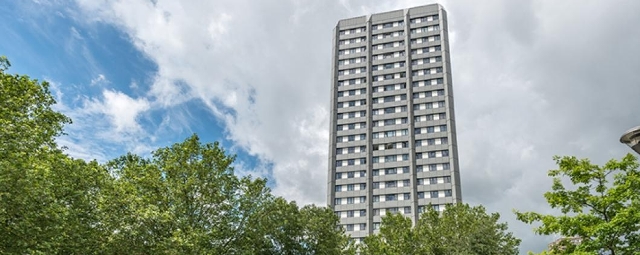
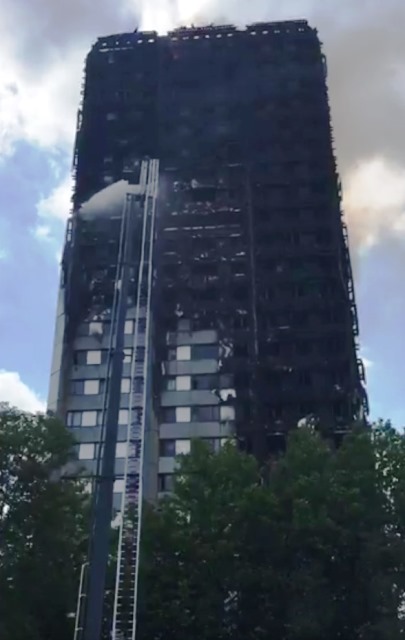
Forty fire engines and more than 200 firefighters and officers were called to the 24-storey Grenfell Tower on the Lancaster West estate in north Kensington at just before 1am on Wednesday 14th June.
Police have confirmed there have been 12 fatalities so far known of and say they expect that figure to rise. Dozens were taken to hospital for treatment.
The fire spread much more quickly than expected on the basis of current building regulations; it burned unabated throughout the day and into the next evening, despite the best efforts of the firefighters. London Fire Commissioner Dany Cotton said: “This is an unprecedented situation, with a major fire that has affected all floors of this 24 storey building, from the second floor up. In my 29 years with London Fire Brigade I have never seen a fire of this nature.”
It soon became apparent that this incident was also the most significant building failure in the capital since the collapse from a gas explosion of the 22-storey Ronan Point in 1968, which led to the introduction of modern building regulations.
Grenfell Tower was built in 1974, to post-Ronan Point standards, with 120 council flats – now social housing. Perhaps significantly, it recently underwent an £8.6m refurbishment, with the addition of Celotex RS5000 aluminium cladding with a composite sandwich core. This was completed only in May 2016.
Several engineers, architects and building surveyors came forward to the national media during the day of the fire to explain that such cladding was meant to have a fire retardant core and was meant to be fixed to the building in such as a way as to prevent the rapid spread of smoke and fire from floor to floor. Passive fire protection was meant to offer much more resistance than was evident at Grenfell Tower; it was supposed to contain the fire. It did not work. This is what makes the incident so significant to the wider construction industry, and why a public enquiry will undoubtedly now follow.
Rydon was the contractor responsible for the refurbishment. Chief executive Robert Bond said: “We were shocked to hear of the devastating fire at Grenfell Tower and our immediate thoughts are with those that have been affected by the incident, their families, relatives and friends.
“Rydon completed a partial refurbishment of the building in the summer of 2016 for Kensington & Chelsea Tenant Management Organisation on behalf of the council. The project met all required building regulations and handover took place when the completion notice was issued by the Department of Building Control, the Royal Borough of Kensington and Chelsea. We are working with the relevant authorities and emergency services and fully support their enquiries into the causes of this fire.”
When that statement was first posted on Rydon’s website it said that the work “met all required building control, fire regulation and health and safety standards”. The reference to fire regulation was later deleted.

The cladding contractor was Harley Facades, whose subcontract was worth £2.6m. Managing director Ray Bailey said: “This is an incredibly tragic incident. Our thoughts are with the residents and their families who have suffered such a personal loss. We will fully support and cooperate with the investigations into this fire. There will be many questions about this whole incident and so you will appreciate that it would not be appropriate for us to comment or for others to speculate on any aspect of fire or it causes in advance of these inquiries. At this time, we are not aware of any link between the fire and the exterior cladding to the tower.”
Other subcontractors on the refurbishment included building services specialist JS Wright, with a £1.8m subcontract, and ventilation systems supplier Witt UK.
With the Grenfell Tower inferno putting passive fire protection in the dock, calls will now intensify for the universal retrofitting of active fire protection in tall buildings.
This was one of the key recommendations of the inquiry into a 2009 fire at the 14-storey Lakanal House in Camberwell that killed three women and three young children. Southwark Council later admitted it failed to address fire risks and was fined £570,000.
Sprinklers are now required by law in new tower blocks but there is no requirement for retrofitting into existing buildings.
Ronnie King, former chief fire officer and now secretary of the All-Party Fire Safety & Rescue Group, told LBC radio that after the Lakanal House fire there was a recommendation for sprinklers to be installed in tall buildings but it was left to councils and landlords to do their own risk assessment.
He said: “Our group recommended that due to the speed that the fire spread in Lakanal House, that building regulations should be reviewed. It's nearly 11 years since it has been reviewed. Successive ministers since 2013 have said they are still looking at it."
There have been five different housing ministers since 2013, including the latest one, who may have to clear his desk to address issues arising here.
Paul Fuller, chairman of the Fire Sector Federation, also spoke out in favour of sprinklers being installed. He told BBC Radio 4: "We know that sprinklers are effective. Also, sprinklers will make the environment more survivable by containing the fire and containing the smoke. But they are not a total solution. We also have to make sure that passive protection measures – things like the structure of the building and the fire resistance of the building – are all properly in place as well."
Labour MP and former firefighter Jim Fitzpatrick said that sprinkler systems - now a legal requirement in similar buildings to Grenfell Tower – should be fitted retrospectively in older blocks.
"At the moment, that's not a requirement, maybe it should be," he said.“If it was built today, it would have to have a fire suppression system; it would have to have an alarm system, it would have to have a sprinkler system. You could not build a building of that height – and with that level of residential risk – without sprinklers."
In the wake of the Cole Report into a wall collapse at Edinburgh's Oxgangs Primary School, questions might also be asked about the role of third-party independent inspection and oversight during the recent refurbishment works.
A spokesman for the London Councils group said: “Local authorities are required to ensure appropriate fire safety procedures are in place in council-run blocks, including processes for risk assessment, inspection and fire improvement works. At present we do not know the cause of the fire and need to wait for the outcome of the investigation before drawing conclusions. Clearly though, boroughs will be reviewing the position locally in light of this tragic event."